Wednesday, June 4, 2008

'Alexandros' is

fitfully successful

in Laguna Playhouse premiere

A new comedy about a dysfunctional Cuban-American family struggles with problems of tone but presents some memorable characters.

By PAUL HODGINS, The Orange County Register
Abuela appraises her 15-year-old her granddaughter Marty for the first time in a decade. "Enorme!" she says, marveling over how much the girl has grown.
"She says you're very beautiful," Marty's mom, Maritza, quickly adds.
That moment near the beginning of "Alexandros," a new play by Melinda Lopez making its world premiere at the Laguna Playhouse, nicely captures its themes. This dysfunctional Cuban-American family walks gingerly on a bed of lies, and Maritza's decision to leave her Miami clan and raise her girl in Texas has created a gulf between Abeula and Marty that a simple reunion won't solve. Their language barrier (Marty doesn't speak Spanish, and Abuela's English is limited) is only the beginning of the problem.
Lopez presents some thorny issues in this script, which was commissioned by the playhouse after positive response to its West Coast premiere of her play "Sonia Flew" last season. But the tone of intermittent farce punctuated by serious interludes isn't always a comfortable fit for the material. And Lopez' attempts to make this family's situation resonate with the bigger picture (it's the summer of 1974, and President Nixon is about to pay the ultimate price for his lies) isn't convincing.
"Sonia Flew," about the relocation of Cuban children in adoptive American homes after Castro's ascendancy, weaved together elements of Magic Realism and straight-ahead drama, and Lopez worked with assurance in that language. Lopez isn't as familiar with the mechanics of domestic dramedy, and at times "Alexandros" devolves into sitcom shallowness.
But at its best, the play achieves what I think Lopez set out to do: illuminate both the tragedy and comic absurdity of a family that copes with past traumas and present difficulties through denial and dissembling.
Maritza (Saundra Santiago) has been persuaded by her brother Tio (Chaz Mena) to travel from her Texas home to see her mother Abuela (Maria Cellario) in Miami. It's Abuela's 75th birthday, but she's in no mood to celebrate. "Welcome to my funeral," she announces to her shocked well-wishers.
The opening scene sets the tone. It begins in the dark, and chaos reigns. Alexandros, Abuela's ancient lap dog, bites Maritza when she tries to greet him. After the lights go up, the frenzy of hugs and kisses excludes Marty (Katharine Luckinbill), who stands near the door, suitcase in hand, looking like a stranger who's wandered into the wrong home. As Marty's sullen attitude and peace-symbol earrings hint, Maritza will soon be in for a couple years of full-blown teen 'tude and open rebellion.
To all appearances, they're a loving and successful family. Abuela lives in a '70s-stylish Miami home. Tio is a busy entertainer on cruise ships. Maritza, whose first husband died, is married to a wealthy Texas doctor, dresses like a well-kept woman and drives a Mercedes. Marty is thriving in an expensive music school, where she studies classical piano.
But all is not what it seems. Why didn't Martiza's husband tag along for the visit? Why did she drive all the way from Texas to Florida? Why does the gardener, an affable guy named Eric (Kevin Symons), insist on dropping in for the birthday celebrations? And why does Tio put on a cheesy Greek accent when he talks to Eric?
These questions and many others are answered in the course of this two-hour show. Along the way are moments of clever comedy, along with stretches of shtick that seem forced. In the second act, when things get more serious and the light of truth is finally shined on everyone, "Alexandros" gains gravitas and, not surprisingly, pulls us in.
Some actors seem more at ease with Lopez' hybrid tone than others.
Mena is well suited to this kind of script. He's an energetic performer who knows how to get a laugh out of manic pratfalls, but his serious scenes are persuasive, too. Santiago has her poignant moments, but seems less adept than Mena at switching from pathos to humor. Cellario plays an archetype – the loving matriarch whose warmth hides a backbone of steel – but brings humanity to the role.
As troubled Marty, Luckinbill's bag of tricks seems limited at first. There's more to seething teen angst than slumped shoulders and bad posture. But Marty is given more pivotal scenes in the second act, and Luckinbill rises to her character's demands when it counts.
Symons plays the story's least plausible character (for reasons that I can't reveal without spoiling the plot), but the actor's powers of charm somehow power through his character's obvious weaknesses.
David Ellenstein directs with a good feel for the dictates of physical comedy, although Marty Burnett's broad, smooth-flowing set presents problems with certain crucial bathroom scenes that even the most capable director couldn't solve. Julie Keen's costumes capture the glorious, colorful train wreck that was fashion in the '70s.
Though "Alexandros" is flawed, it shows promise. Lopez should keep writing in this vein – perhaps even about this clan. There's enough baggage here for five more plays, and I want to see the fireworks that result as new realities are dealt with and everyone endures a family's worst nightmare: a disgruntled and self-righteous teen.
Contact the writer: 714-796-7979 or phodgins@ocregister.com
In Melinda Lopez's comedy 'Alexandros,' a gathering of a Cuban American clan doesn't go as planned.
By David Ng, Los Angeles Times Staff Writer
June 2, 2008
If for no other reason, family reunions exist to give writers ample material for their stories of dinner-table dysfunctionality. There's nothing inherently wrong with that. Other people's domestic traumas have yielded some of theater's finest masterpieces.

Unfortunately, Melinda Lopez's "Alexandros" isn't one of them. This ensemble piece, having its world premiere at the Laguna Playhouse, is a family-reunion comedy that uses ethnic spice to enliven its reheated premise. A Cuban family living in Miami reunites to celebrate the 75th birthday of its matriarch (Maria Cellario). The party brings three generations together under one tempestuous (and pink-tiled) roof.

This occasionally funny play adheres to the family-reunion axiom that buried secrets must be revealed at the most awkward possible moments. The eldest daughter, Maritza (Saundra Santiago), is a vivacious society lady who doesn't want her family to know about her impending divorce from her wealthy husband. Her brother, Tio (Chaz Mena), is a cruise ship performer who prefers to keep his relationship with the family gardener (Kevin Symons) buried deep in the closet.

Emotional catharsis arrives courtesy of two unlikely interlopers. The old lady's lap dog, Alexandros (played by a stuffed animal), experiences a mysterious fate that throws the entire household into chaos. Meanwhile, the granddaughter, Marty, accidentally discovers her uncle's clandestine liaison and must do everything to keep herself from spilling the secret. She's played by Katharine Luckinbill, who is best known as the granddaughter of Lucille Ball and Desi Arnaz.

Perhaps appropriately, much of "Alexandros" plays like a 1950s sitcom. The characters are often pulling their faces into exaggerated expressions and constantly running around the set like a bunch of lunatics. The dialogue seems timed to match an imaginary laugh track. And the obligatory family-values lessons of the third act are dutifully reinforced.

The actual setting of the play is August 1974, on the eve of President Richard Nixon's resignation. The historical backdrop provides some convenient story parallels -- the toppling of authority, the outing of secrets and the beginning of a new era. It's a rather grandiose metaphor for such a modest play, but it does have the benefit of allowing the production team to indulge in garish '70s fashion, including bell-bottoms, big-collared shirts and fluorescent hot pants.

"Alexandros" contains some marvelously off-kilter scenes, most of them involving the flamboyant Tio. In one moment of stress, he performs an outrageously hammy rendition of Neil Diamond's "Sweet Caroline" on the family piano. Later, after much has been revealed, he childishly buries his face in a pillow for what seems like an eternity. Mena's wild but controlled performance turns a cliched role into something verging on experimental art.

The female cast members aren't nearly as successful with their parts, though that's mostly the fault of the playwright, who has created a gallery of stock Latinas. The grandmother is an overbearing matron obsessed with fortune telling, while her daughter is a hot-tempered firecracker who is always breaking out into cha-cha-cha dance moves. But worst of all is the granddaughter, a fully Americanized teenager who is predictably hostile to her ethnic relatives but then comes to embrace the value of her cultural heritage.

Directed by David Ellenstein, "Alexandros" is pitched as a screwball comedy, but the production's aim is slightly askew. The play teeters indecisively between outright frivolity and moments of psychological gravitas. "He was a lot of sad with his happy," says one character, and that line sums up the play's rather unbalanced tone of tragicomedy.

Lopez, whose "Sonia Flew" premiered last season at Laguna, knows how to juggle characters and write fast-paced scenes. But no amount of cleverness, or Latin exoticism for that matter, can conceal that she's essentially serving up leftovers.

Friday, April 18, 2008

Actor transforms into José Martí for one-man show

BY BARBRA HERNANDEZVOZ LATINA

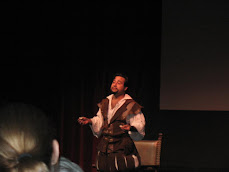
OCALA - Chaz Mena cannot conceal his excitement. Even if he wanted to, the joy in his words would be enough to give him away. He speaks of Cuba and its heroes with nostalgic pride. The same one his father, an exiled Cuban, instilled in him as a child.But among all the men and women Mena grew up listening to stories about, the name of José Martí evokes special memories."Martí, to me, is like a family member," Mena said in a telephone conversation. "It's hard to be Cuban and talk about him objectively because it's like talking about an uncle or a cousin."Today, the childhood stories take on a bigger meaning as Mena prepares to embody the renowned Cuban independence leader. The seasoned actor will recreate moments in the life of Martí in the theatrical performance "Charla: A Chat with José Martí". In it, members of the audience will be able to "interact" with the famous political figure.Mena will take the stage at 7 p.m. Tuesday at Central Florida Community College's Webber Center. Admission is free and open to the public.Born in New York to Cuban parents, Mena grew deeply interested in his cultural heritage at an early age. Martí's name, he acknowledges, was as common in the Mena household as that of any other family member.The revolutionary's literature accompanied Mena almost at all times. He especially recalls how, as a drama student in Russia, Martí's poetry served him as inspiration."Every time I read his verses, I pulled out more strength. It restored my spirit," Mena said.All the years of reading and listening about his favorite Cuban leader were but a preamble to Mena's transformation into his latest role. Becoming Martí represented a challenge - one he was not willing to give up.With a research scholarship from the Florida Humanities Council, Mena plunged into Martí's extensive literature, translating and condensing ideas into a 45-minute performance. Most of the script is based on the political discourse "With All and for the Good of All."Remaining objective, Mena says, was the hardest part about a project that took him nearly six months to prepare for."My investigation of the character mostly focused on divorcing the person from the myth," Mena said. "I wanted to focus on a personal level because I had to transform into him ... not an easy thing to do."The presentation follows the Chautauqua style, a theatrical model that was pioneered in New York near the turn of the 19th century. In it, actors recreate the life of a historical figure and interact with the audience as though they were the person they embody.Although Mena in no way denies his admiration of Martí, he says he aimed for a faithful characterization of the revolutionary. Dressed up in an epoch costume and wearing a thick mustache, Mena will receive his audience with one purpose in mind."I want them to learn more about Martí and the sociohistorical context of 1891," he says. "We should not deify our heroes. Instead, we should think about them, or through them."

Tuesday, March 11, 2008

Everything Goes Right, Delightfully, After Frau Loses Her Underpants

From: The Cleveland Plain Dealer

Date: March 8, 2004

Author: Tony Brown

The Underpants” is exactly the kind of entertainment the Cleveland Play House has been searching for: a play smart enough to be considered literature and slam-bang funny enough to qualify as slapstick.

It’s an unbeatable combination that gives us a fun and funny night out that will also satisfy a theatergoer’s hunger for just a little substance.

Although the pacing is a tad slow — the Cleveland production runs about 10 to 15 minutes longer than the zippy, 90-minute version seen off-Broadway in 2002 — the Play House gets just about everything right in this comedy about sex and sexual politics.

The play, about a neglected housewife, Louise Maske, who loses her underpants in public one day and suddenly finds herself pursued by strange men, began life in 1910. It was one in a series of social satires by German playwright Carl Sternheim, who saw his job as poking fun at the grim culture that would someday produce both Adolf Hitler and the Volkswagen Beetle.

Steve Martin, the wild-and-crazy guy who proved himself a playwright in 1993 with “Picasso at the Lapin Agile,” takes Sternheim’s already very funny play and sticks a comic arrow through its head.

The resulting play has a quaint, old-time comic feel with a hip, post-feminist edge. There are a couple of clunkers among the flood of jokes, and the story at brief intervals feels a little like a “Saturday Night Live” sketch that is about to go on too long. But the play just barrels ahead, and you can’t help going along for what turns out to be a happy ride.

Most significantly, Martin adds a twist to the ending, introducing a Molieresque deus ex machina to the dramatis personae, a royal character who allows our heroine, she of the fallen bloomers, to triumph over all those exasperating men.

The Play House production, directed with invention, if not always with alacrity, by Artistic Director Peter Hackett, starts off right, from the first instant we see set designer Bill Clarke’s witty take on Dusseldorf’s industrial/suburban landscape.

As Louise’s thoroughly shocked and selfish husband, Theo, Chaz Mena looks like a roly-poly, barbershop-quartet version of a pipsqueak Hitler, the kind of guy who enjoys scolding his wife for being beautiful: “You are much too attractive for a man in my position.”

Happily, Tanya Clarke’s Louise proves him absolutely correct, with her blond ringlets and her cheeks rouged liked a doll’s, not to mention the frilly underthings costume designer Kristine Kearney provides her with. Louise endears us with her innocence while at the same time agreeing to engage in an extramarital affair as a series of men suddenly start showing up, ostensibly to rent a room from the Maskes.

It’s an illicit affair that never takes place, thanks to the flustered urbanity of Sam Gregory as Frank Versati, the poet who is too in love with his words to actually make love to Louise.

Louise gets encouragement from upstairs neighbor Gertrude, played with a randy brand of nosiness by Johanna Morrison. Brad Bellamy works tirelessly as Benjamin Cohen, a shaggy barber who denies his Jewish heritage with the same fervor with which he attempts to protect Louise’s virtue from Versati.

And, as an oddball scientist named Klinglehoff, who really does only want to rent a room and knows nothing of the underpants incident, cutely hapless Ron Wilson brings an extra dose of eccentricity to the proceedings.

Hackett and company play Martin’s surprise addition to Sternheim’s original script with fanfare and blinding light and fog, which may at first seem like a bit too much.

But all the hoo-ha proves just the thing to go out on. And “The Underpants” proves to be just the thing the Play House has been desperately in search of: a bit of a laugh, along with a bit of something to think about on the way home with your own spouse.

The rabbi has something to say

From: The San Diego Union-Tribune

Date April 2, 2001

Author: Anne Marie Welsh

Like the wisdom of the Meister Eckhart or Lao-Tzu, the tales of Rabbi Nachman, the last Jewish mystic, come down to us as sayings: "Through joy the spirit becomes settled; through sadness it goes into exile." So what's the meaning of a 225-year old enigma in the age of information? Everything, it turns out, for Elliott Green, the San Francisco nebbish who leaves word processing behind when he meets the rabbi and his creations during Yehuda Hyman's wild and raw music-and-dance fable, "The Mad Dancers."

The quirky and surprisingly funny work-in-progress opened Friday at the Lyceum Space as the kickoff to the Lipinsky Family Jewish Arts Festival. Don't worry, be happy, "The Mad Dancers" doesn't require much historical knowledge of the rabbi from Breslov, impersonated here by John Campion, in a wizardly shape-shifting performance as sweet as it is sharp. Philosopher Martin Buber, who compiled and commented upon Nachman's 13 published tales, said the nature-loving mystic told his Hasidic stories in response to questions from his disciples. How to rejoice in the midst of sorrow? The answer to that one came in "The Seven Beggars," the only tale the rabbi did not finish and the one that inspired Hyman's still-in-process musical.

It opens with Nachman and four followers gathered for one last story-telling session, a confab that rises magnificently into song, before the beloved rabbi fades away from consumption. Stroking the cheeks of his dear friends, his eyes lit with love, Campion's Nachman pulls us into the narrative, himself becoming some of the beggars, speaking cryptically, time-traveling to meet Elliott, the IBM-er chosen to become a prince of the soul. "May you be as I am," the rabbi-as-blind man tells Elliott, planting a big wet one on the baffled crack typist's cheek.

The nerdy anti-hero meets other beggars bearing messages, his strange journey punctuated by comedy sketches, some so hilarious they could play "Saturday Night Live." Leaving his cubicle behind early on, Elliott heads out onto San Francisco's Market Street for the compulsive ritual of his morning break. Sip, Bite, Read. A latte, a chocolate croissant, the Chronicle. Sip Bite, Read. Madonna. Britney Spears. Johnny Depp. Writer/choreographer Hyman plays Elliott with a bewildered innocence that's part Bill Murray, part Candide.

A later sketch is the comedic high point. Elliott has almost made it to the allegorical garden planted by a deaf, sign language-speaking farmer (Jaye Austin-Williams). Instead he chooses the seductions of the Cafe Torrero where a belly dancer undulates, pillows cushion his generous behind and a manic waiter (Chaz Mena) describes the oiling, spicing, rolling, and baking of a chicken with sex-chat gusto.

There's a wonderful Yemenite song for Steve Gunderson, the local musical comedy pro who's thoroughly convincing in the curls and robes of a disciple. And playing multiple tempters and villains is Dimiter D. Marinov, sleek, sly, and insinuating.

Director Todd Salovey has managed to unify an evening of many conflicting strands and styles, mostly by the strength of his cast, though also by the simple imaginative power of the staging. The ensemble often performs, whether dancing or not, with the unanimity of a dance company.

Still, there's a flatness to the action as its sprawling, fairy tale-like narrative circles around a couple of themes rather than gathering momentum and moving forward. Elliott Green is a satiric creation and as he moves deeper into the mystic tales, we expect a soul-revealing discovery, a kind of emotional sea change. Instead the ending relies on external dramatic events, and feels tacked on rather than organic.

Performances, however, are tiptop. Campion has been here often in tough, scary roles, including Yank in "The Hairy Ape" at La Jolla Playhouse, and the sicko womanizer Menelaeus last year at the Old Globe. The range of his talent is quite amazing in "The Mad Dancers." As Elliott Green, Hyman brings sharp timing to the Yiddish humor and infectious moments of abandon.

If the slow-going second act could find the more effective rhythms of the opening scenes, the show might be more consistently compelling. With some deepening of Green's character, and an ending that feels more organic, Hyman and Salovey's revised piece could have a joyous theatrical impact that exactly parallels its life-giving mystical message.

WELL-VERSED ACTORS BRING BLOODY POETRY TO LIFE

From: The Miami Herald

Date: November 2, 1993

Author: CHRISTINE DOLEN

You might assume that a play about Percy Bysshe Shelley and Lord Byron, those two great and decidedly unconventional 19th Century British romantic poets, would be arty and full of more poetry than you've heard since freshman English. That it would be a literary history lesson, probably a little on the dull side.

Wrong. Oh, I'm sure you could dramatize the Shelley-Byron relationship that way, but British playwright Howard Brenton certainly defies all those expectations in Bloody Poetry, his 1984 play now being given a thrillingly acted revival by the Florida Shakespeare Festival.

With its second production since Hurricane Andrew's destruction led to a change of both venue and administration, the Coral Gables company further demonstrates its commitment to excellence, staging a provocative play that probably wouldn't otherwise be seen here -- and doing it very, very well.

Bloody Poetry IS a play of ideas, but it also is as juicily lusty a script as you could want. It's a ready-made romp for good actors, and the six in Florida Shakespeare's company dare to play it big. Under John Briggs' intelligent, many-layered direction, they vividly convey the story of reformer-dreamers who inevitably left sorrow in their wake.

Bloody Poetry, whose title is both a curse and a vivid evocation of the poets' duality (artistic genius coupled with spiritual chaos), spans the time from the first meeting of Shelley (John Baldwin) and Byron (Chaz Mena) at Switzerland's Lake Geneve in 1816 to Shelley's drowning in Italy in 1822.

Along for the exhilarating/misery-filled sojourn are Shelley's common-law wife Mary (Liz Dennis), then working on Frankenstein, and her charismatic sister Claire Clairemont (Blaine Dunham), the unapologetic mistress of both men. Also on hand are Byron's biographer, Dr. William Polidori (Adam Koster), to serve as a scandalized narrator; and, first as a guilt-inducing spirit, then as a ghost, Shelley's legal wife, Harriet Westbrook (Stephanie Heller).

The actors artfully convey the discrepancy between philosophy and action. When Shelley receives word of Harriet's death (pregnant by another man and long ignored by her husband, she drowned herself in a shallow lake), Mary's first reaction is to ask the distraught Shelley to marry HER, though they have both disdained the institution of marriage. Free-loving Claire, pregnant with Byron's daughter, schemes fruitlessly to wed the overweight, alcoholic, syphilis-ridden poet, who freely admits he prefers making love to boys. These four are unconventional in the extreme and, for all the pleasure it affords them, it also leads to misery and the deaths of their illegitimate children.

The acting, as noted, is wonderful.

Baldwin, often seen with the Acme Acting Company, is strikingly handsome in his frequent agitation, and he artfully conveys the disparity between Shelley's political idealism and his careless amorality. (You should know that the script calls for him to moon the audience, but the moment is brief and tastefully done.)

Mena, one of South Florida's best and most versatile actors, brings a detailed wantonness to his Byron, giving the man a slight hobble and a drunken expansiveness. His is the most over-the-top performance, but it works.

Dennis' Mary initially seems much too restrained, but her cool logic and wounded spirit makes the choice work, as well as providing a contrast to the flamboyance of the others. Dunham is a revelation, making Claire a husky-voiced yet childlike seductress who actually seems to glow. What an alluring performance!

Bloody Poetry is really a kind of ghost story, so David Trimble's classic and simple set -- white curtains, behind which spirits can be outlined in shadow -- is a striking and effective design choice.

If you see Bloody Poetry -- and you should, if you love good acting -- you will most certainly hear some of the verse that made Shelley and Byron literary legends. But you will also get lost in the far more complex and less orderly lives of geniuses who couldn't shape their lives with anything close to the skill they brought to their poetry.

Havana: Self-Indulgent Destination

From: The Cincinnati Enquirer

Date: September 29, 2002

Author: Jackie Demaline

Playhouse in the Park's Shelterhouse embarks on theatrical adventure this season, inviting audiences to places they haven't been before.

First stop: Havana, an attempt to discover identity by revisiting the past, a tentative and complicated gay love story (featuring some brief, heavy necking).

The play, in fact, opens with Federico (Chez Mena) in bed (alone), speaking what, to a melody, would be the sappiest of love songs with gushy rhymes and overly rapturous allusion. This love song isn't to a longed-for partner, it's to a long-lost homeland.

Look a little more closely at the largely bare stage and, inlaid in a Caribbean blue floor the silvery shape of Cuba slashes a diagonal across the playing space.

Federico (clearly a stand-in for playwright Eduardo Machado, who is in part inspired by personal experience) was one of the 14,000 Cuban children sent to the United States back in 1960 on now-controversial Pedro Pan airlifts, as parents tried to save their children from a life under Fidel and Communism.

Federico has been consumed by that rupture in his life for three decades. The play's topic is his eventful first return trip to his homeland even as the issue of a new lost boy, Elian Gonzalez, rages around him.

Under the sure hand of director Ron Daniels, Mr. Machado's drama gets a far better production than in its world premiere two years ago at the Humana Festival of New American Plays (under the title When the Sea Drowns in Sand).

Federico and his "straight" best friend Fred (Paolo Andino) and their Cuban driver Ernesto (Antonio Edwards Suarez), play off each other beautifully as they explore definitions of identity, friendship - even patriotism.

The topic "embargo" is intermittently dropped into the conversation, usually with the grace of a lead balloon - Mr. Machado doesn't blend the personal and political with ease.

The performance is flavored by the underscoring of Richard Marquez, playing a variety of Cuban drums on a tiny balcony overlooking the stage.

But Havana is also underscored, far more monotonously, by the "me-me-me" of Federico's self-involvement.

Mr. Mena does a terrific job of making Federico, an essentially egocentric, self-concerned intellectual, likable.

But his gleeful, ongoing self-torment - "Did I abandon my country? Did it abandon me?" - gets old, in large part because, as a 9-year-old, it wasn't his decision to stay or go.

I couldn't help thinking the playwright is as self-indulgent as his central character, whom he has romanticized even as he avoids the scariest questions - and most pertinent - dramatic questions like "Why can't I let go?"

Leading off a Shelterhouse season that is going to be risky business compared to the recent past I wish the risks were being taken for a better play.