Monday, December 27, 2010

2010 OUR YEAR IN REVIEW - (Mentioning Chaz Mena & Avi Hoffman in The Quarrel)


THEATER

by Christine Dolen
MIAMI HERALD

December 26, 2010


The economy played the villain (again) in South Florida theater, leaving the venerable black theater troupe M Ensembletemporarily homeless, keeping younger companies like Ground Up & Rising and The State Theatre Project on the move, forcing even the most established theater companies to find creative ways to do more with less.  And yet they do: Boca Raton's Caldwell Theatre Company did another concert version of a big Stephen Sondheim musical, this time FOLLIES;GableStage took slimmed-down Shakespeare into the schools; the Internatioanl Hispanic Theatre Festival (now 25) and CityTheatre's 15-year-old Summer Shorts celebrated anniversaries that stand as testaments to art and adaptation. 

Serious Spanish-language theater continues to blossom, enough so that Teatro en Miami founders Ernesto and Sandra Garcia cooked up TEMFest 2010 to showcase homegrown fare.  Meanwhile, despite the announcement a year ago thatGableStage's Joseph Adler would become artistic director at a smaller-sized Coconut Grove Playhouse, local theater's most drawn-out drama - will Miami's historic theater, closed since 2006 and coveted by politicians, corporations and developers, every really reopen? - continues to unfold at a molasses-like pace.

TOP FIVE


1.  GREAT PERFORMANCES:

A few actors pushed their craft to a higher level, including Barbara Bradshaw, as a complex short-story writer in Mosaic Theatre's COLLECTED STORIESElena Maria Garcia as the conniving tastemaker in Zoetic Stage's SOUTH BEACH BABYLONGregg Weiner and Erin Joy Schmidt as a couple in marriage meltdown in GableStage's FIFTY WORDSSchmidtand Ricky Waugh in Mosaic's DYING CITY and Chaz Mena and Avi Hoffman as Holocaust survivors sparring over God and faith in GableStage's THE QUARREL.


2.  MOST DARING:

GableStage's BLASTED by the late British playwright Sarah Kane featured the most fearless acting ensemble.  Artistic director Joseph Adler deftly plunged performers Todd Allen Durkin, Betsy Garver and Erik Fabregat into Kane's mysterious, hellish representation of the infinitely varied nature of human cruelty.  The designers' depiction was just as artful.


3.  SOUTH FLORIDA ONSTAGE:

Playwrights Christopher Demos-Brown and Michael McKeever turned the spotlight on life in a place where it's hard to top real-life headlines - Demos-Brown in WHEN THE SUN SHONE BRIGHTER, a Florida Stage world premiere about a Cuban-American Miami mayor contemplating a run for the U.S. Senate; McKeever in SOUTH BEACH BABYLON, the Zoetic Stage Company's debut at the Adrienne Arsht Center for the Performing Arts.


4.  SUCCESSES RECONNECT:

Pulitzer Prize-winning playwright Nilo Cruz, Tony nominated actor Raul Esparza and award winnning playwright Tarell Alvin McCraney are Miami talents, who have had major influence on theater nationally and, for McCraney and Cruz, internationally.  Each came back to work at home - Cruz for the world premiere of THE COLOR OF DESIRE at Actors' PlayhouseEsparzafor an electric performance in BABALU at the Arsht Center, and McCraney for a fund-raising evening (built around his acclaimed BROTHER/SISTER PLAYS) to benefit students at his alma mater, the New World School of the Arts.


5.  BROADWAY BRILLIANCE:

A pair of Tony Award-winning, music-driven shows - IN THE HEIGHTS at the Broward CenterSPRING AWAKENING at theArsht Center - rose above the same old spectacle-driven fare to tell captivating, brilliantly performed stories.

Tuesday, June 22, 2010

Talkin' Broadway Review by John Lariviere


 The Gablestage, in association with The Sue & Leonard Miller Center for Contemporary Judaic Studies, U.M., presents the Southeastern premiere of the play The Quarrelby David Brandes and Joseph Telushkin. The Quarrel is based on the Yiddish story My Quarrel with Hersh Rasseyner by Chaim Grade (1910 -1982), who is considered one of the foremost Yiddish writers of the modern era. The Quarrel describes the chance meeting of a Holocaust survivor with an old friend from the mussar Yeshiva. The narrator (Chaim Kovler) has lost his faith, while the friend (Hersh Rasseyner) has continued to lead a pious and devoted religious life. The former friends debate the place of religion in the postmodern world.
Set in the early fall of 1948, The Quarrel takes place in the Mount Royal Park in Montreal, Canada. There the random meeting of old friends Hersh Rasseyner (Avi Hoffman) and Chaim Kovler (Chaz Mena) starts a day filled with recollections of their shared past, and discussions of the divergent paths their lives have taken since they last saw each other. The closeness the two men once shared in their common religious belief system seems gone, and they struggle to find a mutual sense of understanding and respect for one another. Their story does not focus on the sadness of their Holocaust experiences, but how the essence of their religious beliefs allows them to process these experiences in their new lives. Hersh embraces his faith with strength and conviction, while Chaim has put his own faith aside. The script avoids the two men arguing about the technicalities of their different religious beliefs, and leans toward them arguing about their friendship instead. As many relationships are damaged over differences in religious, political and lifestyle choices, the appeal of this story is universal.
Avi Hoffman's portrayal of Hersh Rasseyner is heartfelt and true. He shows a kindness that allows his convictions to pour forth without the declarations sounding judgmental or harsh. His character's connection to his faith is so strong that it seems like many moments are also personal truths for the actor. Chaz Mena as Chaim Kovler matches Hoffman's ardent portrayal with one that is smooth and emotionally detached (save for one brief moment) from the subject of religion. This works well, as again the focus remains on the friendship, and one can sense his character's detachment is a defense mechanism. The dialogue between the two actors shows excellent pacing and timing, and avoids milking the audience for response. The role of Joshua, played by Mark Della Ventura, stops rather than furthers the action in his brief appearance on stage. He is clearly out of his league with two such seasoned actors, and looks petrified on stage. Most of the play involves just the two main characters, and this production is well acted by Hoffman and Mena, and very cleanly directed by Joseph Adler.
Chaim Grade was born in what is now Vilius, Lithuania. He received a secular as well as Jewish religious education, studying for several years with one of Judaism's great Torah scholars, Rabbi Avrohom Yeshaya Karelitz, the Chazon Ish. In 1932, Grade began publishing stories and poems in Yiddish, and in the early 1930s was among the founding members of the "Young Vilna" experimental group of artists and writers. During WWII Grade fled to the Soviet Union and lived briefly in Poland and France before relocating to the United States in 1948. His postwar poetry is primarily concerned with Jewish survival in the wake of the Holocaust. Among his novels, novellas, short stories and poetry are works such as The Sacred and the Profane, The Yeshiva and Mayn Krig Mit Hersh Rasseyner.
The Quarrel will be appearing at The GableStage through May 23, 2010. The GableStage is located in the eastern section of the Biltmore Hotel, at 1200 Anastasia Avenue, in Coral Gables, Florida. Valet parking is available, or free parking is available in the Biltmore parking area west of the hotel. Performances are 8 p.m. Friday-Saturday, 2 and 7 p.m. Sunday. Tickets are normally $42.50 Friday-Saturday and Sunday matinee, $37.50. For tickets and information you may reach them at 305-445-1119 or on line at www.GablesStage.org. The GableStage, formerly known as the Florida Shakespeare Theatre, is a professional theatre presenting classic and contemporary theatre year round. They are members of the Theatre League of South Florida, the Florida Cultural Alliance, the Theatre Communications Group, SouthFloridaTheatre.com and the Dade Cultural Alliance. The GableStage hires local a nd non-local Equity and non-union actors and actresses, and is involved with the educational community in promoting educational theatre programs.


Monday, June 7, 2010

Summer Shorts, 2010--Miami Herald Review, 6/7/10

Annual fast-paced Summer Shorts Festival runs hot, cold

BY CHRISTINE DOLEN

City Theatre's annual Summer Shorts Festival, the event that signals summer for any theater-crazed South Floridian, has just kicked off its 15th edition at Miami's Adrienne Arsht Center for the Performing Arts.

Both the eight short plays in Signature Shorts and the seven in the R-rated undershorts offer the mixed-bag experience of festivals past: Some shows will make you flip, while others flop. True, the “agony” of a weird/flawed play doesn't last long, and there's usually something moving or hilarious just minutes away. Still, you'd think that picking 15 gems from 1,200 submissions might be a little easier than it seems to be.

Among the pleasures of Summer Shorts is watching a top-notch acting ensemble. Chameleonic actors do best in this quick-change format, and this year's standouts are Stephen ``Mr. Summer Shorts'' Trovillion, David Hemphill and Chaz Mena among the men; Laura Turnbull and Elena Maria Garcia among the women. Erin Joy Schmidt, Scott Genn and Breeza Zeller also have some touching or funny moments, but their fellow actors make more of better roles.

The multicharacter hits in Signature Shorts are the opening play, Jay Rehak's The End of a Perfect Game, about a pitcher (Genn) having an existential crisis at the end of the seventh game in the World Series; the reprise of Rich Orloff's Matterhorn, about a couple (Trovillion and Garcia) parsing their marriage while waiting in line at Disneyland; and the closing black-comic piece Not a Creature Was Stirring by Christopher Durang, in which Trovillion plays a tyrant-father to Turnbull's housewife with a dark side.

Two intense solo pieces are also memorable. Trovillion plays a teacher who relates the story of a childhood tragedy in Dan Dietz's Lobster Boy; initially in pure lecture mode, he pushes into emotion at just the right moment, carrying the audience along with him. In Bridget Carpenter's Euxious, the compelling Turnbull portrays a mom and way-stressed executive being questioned after an accident involving a mysterious phone call that takes the play to an other-worldly place.

Susan Westfall's Look at Me, about a troubled veteran (Genn) and the wife (Zeller) determined to reignite their passion, is hampered by less-than-riveting performances from both actors. And both Gregory Hischak's Poor Shem (about a guy done in by a copying machine) and John Olive's Iddle Minglish (about a pair of communication-challenged guys spat into a strange dimension -- or something like that) are reminders of how very strange absurdist theater can be.

The bawdy, adults-only undershorts starts off with a bang -- specifically, Michael Elyanow's Banging Ann Coulter in which a monstrous version (Turnbull) of the hate-spewing conservative babe is portrayed as a gal who gets it on with one and all. Other pieces have their moments, thanks to the actors: Hemphill as an on-the-make college loan advisor in Bekah Brunstetter's Daddy Took My Debt Away; Mena as a cheater who can't believe his mistress (Turnbull) is cheating on him in Susan Cinoman's Beds; Hemphill and Genn as Sizzler employees whose love of extreme experiences eventually leave both of them naked (except for gigantic fake penises) in Rolin Jones' Extremely.

Not so hot are Joshua James' F**k You!, in which actors repeatedly hurl the title phrase at the audience, and Laura Eason's It Was Fun While It Lasted, an oddity that squanders the considerable talents of Mena and Schmidt.

But the second-to-last piece in undershorts is so worth waiting for: In James' The Pap, Garcia and Hemphill play experienced patient and brand-new gynecologist, and though they keep their acting real, the two offer a master class in how to milk every imaginable laugh from observing a woman in stirrups with nary a horse in sight.


Christine Dolen is The Miami Herald's theater critic.


Wednesday, April 28, 2010

Miami New Times' Review, 4/27/10


GableStage and the New Theatre on plucking your eyes out

Tuesday, April 27, 2010

The Quarrel at Gables Stage, Closing May 23, 2010


CDOLEN@MIAMIHERALD.COM


The argument has been going on for centuries, transcending any particular faith. One thread goes something like this: If there is indeed a God, if He is responsible for man's moral and ethical behavior, why does He allow suffering and tragedy to befall the faithful? How, in particular, could the Holocaust happen?
The Quarrel, a play by David Brandes and Joseph Telushkin that has just opened at GableStage, asks dozens of such questions during the unexpected reunion of two old friends, one a worldly poet, the other a rabbi.
Originally a Canadian film based on a 1950 short story by Yiddish writer Chaim Grade, The Quarrel is now an intense, emotion-filled, provocative piece of theater brought vibrantly to life by director Joseph Adler, starring Avi Hoffman and Chaz Mena and, in a small but incendiary role, Mark Della Ventura.
In less than 90 minutes, Hoffman and Mena paint portraits of two men whose youthful friendship shattered over questions of faith, men who lost everyone and everything during the Holocaust.
In the rhythms of their sometimes volatile debates, they reveal the boys they used to be when they were at a yeshiva in Lithuania, their stolen lives as husbands and fathers, their need to reconnect with the past through each other. The work that Hoffman and Mena create together is so moving that, at the end of opening night, one man tried to speak through his tears and couldn't. He wasn't the only one.
Set in a Montreal park in 1948 -- the moody set, with its stonework and mural of pale trees, is by Lyle Baskin -- The Quarrel turns on the chance meeting of Rabbi Hersh Rasseyner (Hoffman), who is preparing to observe Rosh Hashanah, and Chaim Kovler (Mena), a Yiddish poet who has come to Canada from his home in New York to do a reading.
Though each man is elated to discover the other has survived, their conversation soon moves from old friends and family members to their still-festering differences. It takes a while, but Hersh eventually confesses that when Chaim turned his back on the yeshiva and Judaism, he felt broken.
During a rainy afternoon, the two debate questions of faith and morality as they must have at the yeshiva so many years ago. A brief interruption by Joshua (Della Ventura), one of Hersh's students in his Montreal yeshiva, leads to the young man spewing zealous recriminations at Chaim. The attack is an extreme version of what Hersh feels, but its verbal brutality leads Chaim to hit back hard.
As sparring partners, Hoffman and Mena at first seem to be unequally matched. Hoffman's Hersh is soft-spoken, friendly yet restrained. Mena's Chaim is a dashing literary star, a man who's rather full of himself, and the actor is so vividly alive onstage that it's tough at first to give equal weight to the characters.
And yet, as the two watch sundown begin to tint the park's sky pink and gold, they share their stories of guilt and loss, their need for forgiveness. Together, in a combination of mourning and joy, they sing. And that's when we know they aren't so different after all. That's when the tears come.
Christine Dolen is The Miami Herald's theater critic.


Read more

Monday, February 8, 2010

"N.Y. actor immersed in role of Menendez", St. Augustine Record, 8 February, 2010

By ANTHONY DeMATTEO

Preparing for his initial portrayal of St. Augustine's founder last November, Chaz Mena became so enthralled by Pedro Menendez de Aviles, he committed to a lifetime studying the historic figure.
Mena, the New York City actor who plays Judge Marc Montaldo on NBC's drama Law & Order, will portray Menendez again during the Feb. 27 Noche de Gala birthday celebration at The Lightner Museum.
Mena played Menendez -- whose birthday the gala celebrates -- last November in the opening of the "Legacies of La Florida" series sponsored by the city's 450th Commemoration Committee.
Mena has become an amateur historian on the first governor of Spanish Florida, in part, by reading his 16th-century letters to Spain's King Philip II.
"Menendez is important in a lot of ways: cartography, geography," Mena said. "He founded six settlements and is responsible for making the seas outside of Spain safer for commerce. I have accepted a lifelong commitment to learning about your city, the Menendez expedition and how it played out."
On Sunday afternoon, Mena arrived with a Key lime pie at the home of local seamstress Heidi Mosier, trying on the Menendez costume Mosier made for him.
He planned to bring the flan that she favors, but spent too much time practicing sword fighting Sunday to prepare it.
A museum artisan in the Spanish Quarter for almost 20 years, Mosier has been making costumes for local actors for three decades.
She made the Menendez gala costume with the red dagger medallion on its breast in her home, weaving its white collar and sleeve ruffs with her husband's tie rack she modified for the purpose.
"It feels great," Mena said of the new outfit, as Mosier tugged at the garment and quizzed him on its suitability in front of a mirrored armoire. "It's just a wonderful costume."
Mena's wife, Ileana, will attend the gala, playing a friend of Menendez, whose wife Maria did not travel to St. Augustine with him, Stuart said.
Similarities with Menendez
Mena said he and Menendez are similar in at least one way -- a love of family.
"He loved his wife and his kids," Mena said. "He lost his son Juan in Florida, in 1563. That is one reason he thought it important to accept the king's mandate to make the journey."
Menendez never found his lost son, who might have disappeared in Bahamian waters or been captured by natives, said Mena, adding Menendez rescued a group of Christians enslaved by natives in the search. Despite sorrow over the loss of his beloved "Juanino," Menendez continued his mission, settling Florida by different means than Spaniards who previously failed.
"The people of La Florida were not about to be conquered," said Mena, who credits his father Carlos with imparting lessons of his own heritage. "Menendez was going to persuade the founding Floridians into the fold and convince them to be faithful to the crown. And he succeeded. Many natives called him "big brother." That's a clear flight from what the more war-like Spaniards tried to do."
Gala tickets available
Tickets remain for the Feb. 27 gala. Each ticket is $185, which includes the show, a cocktail party, dancing, and a dinner catered by the Casa Monica Hotel. Tickets for the cocktail party alone are $50. Both can be purchased by calling 904-825-5088. Guests are asked to attend in "black-tie" outfits or 16th-Century attire.
The gala begins at 5 p.m. with Mena, as Menendez, leading a precession of about 100 reenactors to the Lightner Museum from the old City Gate. The area outside the museum will simultaneously bustle with gymnasts, fire-breathers, ribbon dancers and re-enactors, all free for public viewing.
The cocktail party will be in Lightner's third-floor ballroom from 6:30 p.m. to 8 p.m. Mena will sword fight with local experts Scott Brewer and Chad Light, sit at a head table at the dinner following the cocktail party and, Noche de Gala Director Melissa Stuart said, interact with guests and entertain in ways not yet revealed.
"I don't know what he has in mind," Stuart said of Mena. "He'll address the crowd above and interact with the colonists."

Monday, December 14, 2009

Timucuan artifacts, Pedro Menendez outline city’s story

By PETER GUINTA, St. Augustine Register

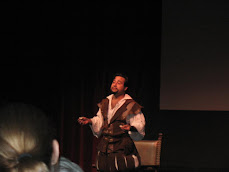
A reflective yet self-justifying “Don Pedro Menendez de Aviles” took the stage Monday at Flagler College Auditorium and recounted details of his founding of St. Augustine in September 1565, his successful attack against Fort Caroline and his massacre of 150 shipwrecked French sailors.
Television actor Chaz Mena portrayed Menendez as passionate, noble, ambitious, callous and devout.
“I am not a conquistador,” he told the packed 800-seat auditorium. “I want to be your founding father.”

The presentation was the second of seven in the Discover First America: Legacies of Florida series.
Just before “Menendez” spoke, Kathleen Deagan, the University of Florida’s distinguished research curator of Florida Museum of Natural History in Gainesville, described the search for archaeological evidence found in scores of digs at the Fountain of Youth and the Mission of Nombre de Dios.
She said he arrived here in five ships of 11 he started with in Spain.

However, the location of his first fort has not been determined, she said.Two accounts contradict one another. The first says the Spanish soldiers dug a trench quickly to act as protection against the Timucuan. The second says Menendez was offered a large house in the Timucuan village of Seloy.
He arrived with 800 people — 300 soldiers, 200 sailors and several hundred “useless” people, he reported. But by November of that year, the colony was down to 200 people

“It was a hard beginning,” Deagan said. “There was hunger and the Indians were becoming hostile.” In 1566, Menendez moved the city to Anastasia Island for seven years, she said.“No trace of that settlement has ever been found,” she said, adding that high tides, storms, seasonal floods and soil erosion may be the reason both sites have not been located.
She did show photographs of the very few Timucuan artifacts uncovered by her digs.
In 1572, Menendez moved the city back to the mainland, to where it is today.When he first arrived, Menendez held the first Thanksgiving in the New World.

“There wasn’t turkey, but garbanzo beans, ham, olives and fish and small game,” she said. “There were very few deer.”

“We are fairly certain that the first fort was somewhere near the area of Hospital Creek,” she said.
The energetic Mena acts in movies, such as “Miami Rhapsody” with Sarah Jessica Parker, plays a judge on Law & Order and performs in off-Broadway plays. His research and performance were so thorough that one might think Menendez had been channeled.
“There is an old Asturian saying, ‘Once you have a reputation, especially a bad one, go to sleep, you cannot change it.’” he said.

He had been a merchant with his own ships when Phillip II, king of Spain, asked him to go to the New World to counter the French, who were already there, he said. He had been with his wife for only four of his 20 years of marriage, he said.He called the Gulf Stream “a river given to the Spanish people by God.”
Trying to explain his sometime cruelty, he said, “I was reared in violence and governments depend on people like me.”