Tuesday, March 11, 2008

O Jerusalem

From: Variety

Date: March 24, 2003

Author: Charles Isherwood

A little irreverence might not be a bad thing when it comes to the endlessly fraught Palestine question. And A.R. Gurney's new play on the subject--yes, I did say A. R. Gurney--starts out in a pleasantly playful manner, promising to bring a light touch to a painfully fraught subject. But the pleasure gradually fades as the play devolves into an odd mixture of soap opera and op-ed column, and by the time it concludes, with the central character, an American diplomat, having become a martyr for the cause of peace, it has all but evaporated.

The play's elaborate conceit presents the text as having been written just after Sept. 11, then lost for some time. We are watching it at some distant time in the future. "Because it is a long, rambling and tormented piece," we are told, the actors narrate and edit as they go along, stepping out of character to explain what's happened in scenes they've decided to skip or shorten.

The story follows the quixotic diplomatic career of Hartwell Clark (Stephen Rowe), an oil man recruited by President Bush, pre-9/11, for a minor post in the ministry of Near Eastern affairs, as it is called. "Why do they say that?" asks his scornful wife, who has no interest in leaving comfy Houston for the scorching deserts. "Maybe it's nearer than we think," comes the answer, suggesting things won't be all fun and games.

Does this slick oil guy, who went to school with W, seem an unlikely figure for such a tense time? "Here's where we've cut some clunky lines which remind us that at this time the Bush administration had turned its back on the Middle East," comes the plausible explanation. "Which makes Hartwell's appointment possible, if not probable."

Such frank interjections continue intermittently as Hartwell dives into his job, although plausibility becomes a problem that can't really be brushed aside by a shrug of the shoulders in the text. Hartwell quickly becomes a figure of controversy when an old flame, a Palestinian intellectual with whom he had an affair at school, Amira (a sharp Rita Wolf), accosts him at a meet-and-greet cocktail party in Jordan and insists on a secret meeting. The womanizing Hartwell thinks romance is in the air, and risks official disapproval by pursuing the relationship.

But Amira has more urgent business. She warns Hartwell of an imminent terrorist attack on the U.S., the info coming from her son, a member of Hamas. More details will follow if Hartwell will take her son's peace plan for the holy land to his bosses. Eventually he does so (both warnings and plan are ignored, obviously), and becomes a crusader intent on finding a solution to the Palestinian problem that puts him at odds with his government's official, staunchly pro-Israel position: "When in God's name are they' going to realize that we are all in this together?" he asks, exasperated at gossip that labels him anti-Semitic for his position.

Unfortunately, Gurney's analysis of this complex territory doesn't get much more sophisticated than that query, which recurs more than once and is ultimately proffered as the play's unifying idea. The implicit suggestion, that the events of 9/11 might have been prevented if the U.S. had taken a more open-minded, and forthright, interest in the Palestinian question, is provocative, but it's also simplistic. And the points that Gurney makes throughout the play--on the hypocrisies and cruelties of U.S. policies, the peculiar attitudes of fundamentalist-Christians toward the question of the holy land, etc.--often reduce his characters to mere TV pundits in street clothes.

The interrelationships among the characters aren't explored with much more nuance. The dialogue tilts toward the soapy. ("We had a good thing going, didn't we, Amira?") And what are we to make of Hartwell's womanizing, anyway? When the fling with Amira doesn't pan out, he hits on another old friend, Sally, a U.S. Information Office exec who is somewhat tangential to the proceedings. If it's an attempt to give him some humanity, it backfires, since he comes off as a bit sleazy and desperate. Or are we to take Hartwell as a stand-in for the U.S.' love-'em-and-leave-'em politics? That's even more iffy.

The play is performed with chipper, informal professionalism by its cast of five, under the brisk direction of Flea a.d. Jim Simpson. But the characters remain two-dimensional, and Gurney's plotting only gets more ham-fisted as the play moves toward its tragic conclusion.

Presenting the text with a self-conscious wink--as if to excuse its implausibility by emphasizing its status as a fablelike commentary on events, not a depiction of them--doesn't really excuse the playwright's simplifications and sentimental contrivances. And the self-editing conceit eventually begins to beckon us: When the actors cheerily make reference to scenes they've edited out, it's hard not to wish the audience, too, could be let in on the process.

`El beso de la mujer arana' y la real validez de la audiencia
From: El Nuevo Herald

Date: January 26, 1999

Author: Norma Niurka

Entre los logros de la novela El Beso de la Mujer Araña, de Manuel Puig, convertida en película y musical de gran fama, se encuentra la perdurabilidad del tema y una extraña flexibilidad para transformarse a otros medios sin perder su esencia.

La novela llegó al celuloide en 1985 con el protagonismo de William Hurt, Raúl Juliá y Sonia Braga; prosiguió su camino de éxitos como Musical de Broadway, en versión de Terence McNally, alternando a Chita Rivera y María Conchita Alonso en un fantasioso papel de diva cinematográfica.

En ambos casos, el argumento gozaba de las ilimitadas posibilidades del cine o del musical, y la glamorosa mujer-araña tenía gran importancia. En el Encore Room, del Coconut Grove Playhouse, se ha estrenado como obra, desprovista de afeites (sin música, bailes, pantalla ni mujer-araña), otorgando a la puesta en escena la validez de la audacia.

Aquí el reto es representarla con el peso de la obra sobre sus dos intérpretes y sobre la profundidad del texto.

El autor ubica en una celda a dos hombres de diferentes extracciones sociales, políticas y sexuales, para confrontar la opresión, los prejuicios, la discriminación en un régimen dictatorial latinoamericano, al tiempo que explora la complejidad de las relaciones humanas.

La confrontación entre Molina, un diseñador de vidrieras, homosexual que se siente mujer, encarcelado con acusación de conducta impropia; y Valentín, heterosexual, marxista militante de una organización clandestina, revela el encuentro entre opuestos que genera un acercamiento de los opuestos; la influencia de las circunstancias en el comportamiento.

En este contexto de sexo y política, El Beso no es una historia de amor en un sentido romántico, pero sus ingredientes realzan las distintas formas del amor, la amistad y la complicidad.

El director Robert Presigiacomo ha realizado un montaje sobrio, sin pretensiones, que enfatiza precisamente texto y actuación. En el reducido espacio que permite este teatro semicircular, donde el público se acomoda alrededor de los actores, éstos gravitan en la celda que les ha tocado compartir, definida por la alambrada de púas que corona el escenario.

Dos camastros marcadamente diferenciados revelan cada personaje: el de Valentín está desnudo y sólo posee un libro; Molina tiene sobrecama de flecos, cojines y portaretratos. Una máscara blanca es el elemento unitario entre ambos ámbitos, la fantasía que va a sellar la relación cuando Molina inicie sus viajes al mundo cinematográfico para ahuyentar el tedio.

La escenografía resuelve los encuentros entre Molina y el carcelero, con una transparencia en un plano superior adonde acude el preso para resumir el diálogo mediante una grabación. El vestuario es correcto, dota a Molina de fantasía e irreverencia, y a Valentín de cierto desparpajo.

En la creación de un Molina divertido, tierno y sufrido, Tomás Milián revela una vez más su ductilidad interpretativa. El actor cubano-italiano, que ha trabajado en inglés gran parte de su carrera, parece buscar siempre papeles que representen un reto, y aquí lo encuentra. El amaneramiento y el patetismo de su personaje es sutil y sostenido, dando lugar a un delicioso careo entre la vulnerabilidad de Molina y la técnica de Milián. Su binterpretación, al desgaire, de una estrofa de un bolero (en español), es un detalle encantador del personaje.

Chaz Mena enfrenta con fuerza el personaje del revolucionario idealista lleno de dudas, encerrado con un homosexual delicado y soñador, que le muestra un aspecto de la vida desconocido para él (los mismos ingredientes que tuvo más tarde Fresa y Chocolate). Su actuación, plena de acciones lógicas, motivaciones y memoria emotiva, es un buen ejemplo del Método, además de que el joven actor posee vitalidad e intención dramática. Sus lágrimas caen ante los ojos de unos espectadores tan cercanos, que fisgonean hasta adentro de una bolsa de papel que éste abre.

La interrelación entre Milián y Mena, aún cuando existe una animosidad subterránea en los personajes, es total. Esto ayudó a superar la lentitud de los primeros momentos de la presentación del domingo. Tal parece que la obra necesita más ensayos para que fluya mejor; y la iluminación pudiera poner más énfasis en Molina, cuando éste se convierte en narrador de películas.

En cuanto a la escena clave de acercamiento entre los dos hombres, el director la resolvió de manera tan lúcida, comedida y precisa, que no se movió ni uno sólo de los cabellos blancos que poblaban la totalidad de los asientos en la matiné del domingo.

Un Universo Entre Rejas

From: El Nuevo Herald

Date: January 22, 1999

Author: Norma Niurka

"Dos personas completamente diferentes en términos políticos, humanos, sexuales, se encuentran en un calabozo y tienen que forjar una relación; no queda otro remedio que compartir ese espacio. Cuando empiezo a ver a este hombre como ser humano, cambia mi percepción de él y cambia el espacio. Lo que era antes un calabozo viene siendo ahora un universo".

Habla Chaz Mena, que interpreta al preso político Valentín, uno de los dos personajes de El beso de la mujer araña. La obra se estrena mañana viernes (en inglés), en el Encore Room, del Coconut Grove Playhouse.

Tomás Milián, la estrella del cine italiano y estadounidense, que vive en Miami Beach desde hace dos años, personifica a Molina, prisionero común confinado por homosexual, quien comparte su celda en una cárcel latinoamer??? ana.

El concepto de Mena sigue la pauta del desaparecido autor de El beso..., el argentino Manuel Puig, quien exploró las circunstancias que llevan a juntarse a dos seres opuestos, y sus consecuencias.

"La obra es una alegoría que se puede aplicar a cualquier conflicto, como por ejemplo el de irlandeses católicos y protestantes", dice Mena, de 32 años, en perfecto español. "No nos queda otro remedio que amarnos".

Mena es conocido aquí por su trabajo en teatro, cine, TV y anuncios comerciales. Ha actuado en Acme Theater, Florida Shakespeare Theater (cuando se llamaba FS Festival) y Area Stage Theater; ha intervenido en episodios de Miami Vice y Wise Guys; y en las cintas Miami Rapsody y Ace Ventura, filmadas aquí.

¿Quién puede decir que este muchacho bailador de son, que conversa en español hasta por los codos, usa palabras como "enjuto" y "forjar", y cita constantentemente a José Martí, nació en Nueva York, se crió en Miami y jamás ha visitado Cuba?

Pues sí, Chaz Mena es un actor "americano" que achaca su hispanización absoluta a la crianza de sus padres, y sus expresiones en castellano a la lectura.

"Siempre viví con mis padres en la sagüesera", apunta Mena, quien llegó a Miami a los seis años de edad, en 1972. "Desde que tengo uso de razón estoy oyendo hablar español, oyendo los cuentos de mi bisabuelo mambí que se hacían a la hora de comer. Oía de este lugar mágico que yo creía no tenía colores porque los retratos que me enseñaban siempre eran en blanco y negro".

A pesar de que el actor está en forma, se puso a dieta para rebajar de peso y, a las 6 de la mañana, se le ve correr por Coconut Grove, mucho antes de empezar los ensayos diarios.

"El personaje debe ser más delgado que yo; quisiera estar enjuto, si pudiera, por la referencia visual, es importante para la obra", explica. "Veo la actuación como un trabajo físico, no cerebral, cada vez que termino una obra, me pregunto cómo soy capaz de hacer las cosas que hace ese personaje".

Mena es un actor del método Stanislavsky, que dio su primera clase de teatro en el último año de la secundaria, en el Miami Senior High School, entusiasmado al ver trabajar a Jim Puig, actor miamense bastante conocido, que en ese momento era asistente de la profesora (también en esa escuela conoció a la que es su esposa desde hace dos años).

Estudió becado en la Universidad de Miami y se graduó de bachillerato en literatura inglesa de Barry University. Empezó a trabajar como profesional en 1988, y sacó una maestría en teatro del Carnegie Mellon, de Pittsburgh, donde estudió con profesores invitados del Teatro de Arte de Moscú, quienes le facilitaron estudiar en esa prestigiosa institución rusa, de 1995 a 1996.

"En Rusia, las artes siempre fueron ayudadas por el gobierno y, desafortunadamente, el arte tenía que ser servicial al gobierno, ayudar en el adoctrinamiento", explica. "Eso lo sé por colegas rusos que me contaban cómo ellos mismos hacían obras de realismo socialista, que odiaban, pero que tenían que hacer. Entonces, cuando yo estuve allá, los teatros ya se tenían que sostener por ellos mismos, y estaban haciendo obras baratas, casi pornográficas".

El joven actor piensa que, en la actualidad, la comercialización del teatro es extensiva al mundo entero.

"Cuando un actor tiene sólo dos semanas para ensayar una obra es porque hay que poner una y después otra, y vender boletos", dice. "Yo creo que el actor es un artesano, si soy muy bueno algun día me llamarán artista, pero no me gusta cómo se usa la palabra artista. Se puede tratar de vivir del arte, pero es difícil ser un artista".

Hace dos años, sintió que estaba repitiéndose en sus personajes y desviando sus metas artísticas. Marchó con su esposa a Nueva York en busca de otros aires, pero siguió viajando entre una y otra ciudad. Aquí lleva un tiempo con los avatares de El beso...

La pieza se estaba ensayando en Area Stage y el local se vio obligado a cerrar. Cuando Arnold Mittelman, director del CGP, quien se hallaba gestionando los derechos de la obra, y se enteró de que ese grupo los tenía, propuso montarla en su teatro. Más tarde, hubo que posponer nuevamente el estreno porque la renovación del Encore Room no estuvo a tiempo.

"Esta es una oportunidad de expresar la opresión en todas las culturas", señala Mittelman. "Aunque el sentido de opresión que la obra dramatiza se siente más en Latinoamérica, la realidad es que la popularidad que ha tenido la obra en todas partes señala que el tema es universal".

Chaz Mena quisiera que el público acudiera a ver la pieza por una razón muy particular: "Me interesa que por un rato se congregue un grupo de personas para pasar un buen rato, pero también para celebrar todo lo que es humano".

Tuesday, November 27, 2007

José Martí at NCU, ACTOR PRESENTS DIALOGUE WITH JOSÉ MARTÍ

by Sara Weist, Co-Editor
Daily Tar Heel

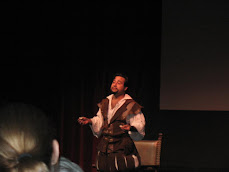
Chaz Mena, an actor from Florida, came to UNC on Nov. 17 to perform a short theatrical work about the life of José Martí.

Cuban intellectual José Martí (1853-1895) is most famous for his works of literature, his diplomatic endeavors and his role in the fight for Cuban independence from Spain. "He's like an uncle, like a member of the family, he's always there," Mena said. "You just can't get rid of him. He's always there; he's always present." Mena's presentation was in the Chatauque style, which is a dramatic attempt to represent a historical figure outside the context of a specific scene. This Chatauqua work was in the form of a conversation between the audience and the historical figure Martí. Kathy Ibarra, a UNC junior, said she liked the Chatauqua style. "It made it possible to speak with a historical figure that no one from our generation will ever be able to talk to," she said. "I am studying abroad in Cuba in the spring, so for me this was an awesome opportunity because Martí is a very important figure in Cuban culture." In the presentation, Mena spoke about the all aspects of Martí's life, both personal and political. "The Spanish say that in Cuba we are bitter," Mena said. "We are not bitter; we are dying." Mena also spoke about Martí's family life. "I was married, but my wife has since left me and returned to Cuba," he said. "But sometimes in the mornings, I feel something, and I know that what I am feeling is that my son is going to wake up." Mena is traveling throughout the country presenting his work, and he said he was especially looking forward to coming to UNC. "I was really excited about coming to UNC, more that anything because of what I had learned about Louis Pérez and the work that he is doing here," Mena said. Pérez is a history professor and director of the Latin American Studies program. His research focuses mostly on the history of the Spanish-speaking Caribbean during the 19th and 20th centuries. Pérez, who also attended the performance, said he was happy with how things had gone and he thought it is important for more people to learn about the life of José Martí. "I want everyone to read Martí's works," he said. "He is a central figure in the history of Latin America."

Monday, November 19, 2007

Miami Dade College Forum, “Telling a Hero’s Story Through Interactive Performance”

MONDAY, NOVEMBER 19, 2007

Author: Christopher C. Gregory-Guider

Although the celebrated Cuban Icon and writer Jose Marti died more than a century ago, actor Chaz Mena talks about him with an infectious immediacy and intimacy. “Marti was a constant subject at the dinner table when growing up, “ says Mena. “He was like a member of the family.”
With a grant from the Florida Humanities council, Mena immersed himself in Marti’s voluminous writings over the past year in preparation for a one-man theater production that will bring the fallen Cuban hero to life. In a return to the city where he spent his formative years, Mena will perform “Charla, A Chat With Jose Marti in the Chapman Conference Center on MDC’s Wolfson Campus. The performance promises to shed new light on Martí’s tireless efforts to expose injustice and his role in Cuba’s long struggle for independence.
Mena anticipates that the theme of the performance will deeply resonate with his Miami audience, but he is quick to point out that the play ultimately promotes a universal message that transcends any one ethnic group. “The message of quality Marti expressed through his life and writings is one that applies to all and one that has special meaning to Floridians,” Mena explains the connection to Florida is immediately apparent in Mena’s performance, which focuses on Marti’s trip to Ybor City in 1891 as part of his efforts to rally the region’s Cuban exiles to rise up against colonial Spain.
The play is far more than a history lesson, though. Performed in the Chautauqua style –a mode of theatre originating in fin de siecle New York—audience members will be able to interact with Mena’s character and pose questions, much as would have been the case in Marti’s actual discussions with South Florida’s late 19-century Cuban community.
Marti’s championing of the cause of the downtrodden was not without cost. He was imprisoned and deported multiple times, although Cuban officially gained independence from the U. S. in 1902, Marti was not destined to see it: He fell at the Battle of Dos Rios on May 19, 1895 after charging Spanish troops.
“Charla” A Chat With Jose Marti proves that Marti’ spirit has secured an afterlife through artists like Mena, whose performance reminds us that history is not a closed chapter of the past, but a living and breathing voice that continues to call out to us in the present.

Saturday, November 10, 2007

AJT kicks up its heels with 'Fiddler'


Kerry Lengel
The Arizona Republic
Oct. 12, 2007 03:15 PM

Arizona Jewish Theatre has been one of the few troupes in the Valley to consistently challenge its audience with new work. But to kick off its 20th season, the company takes a four-decade detour to revive Fiddler on the Roof.

It's a fitting choice, and not just to celebrate two decades of artistic growth. With this production, the theater also launches a partnership with Paradise Valley Community College. The school's Center for the Performing Arts is almost new (it's 2) and offers posher digs and better technical capabilities. So it makes sense to show off the new venue with a big, beautiful spectacle.

That's Fiddler, for sure. Originally produced in 1964, it held the record as Broadway's longest-running musical for nearly a decade, until Grease came along. And it's still a favorite for its rich score, which includes the lovely Sunrise, Sunset.


The Phoenix company rises to the challenge with a gorgeous set that includes foldout houses to keep the scenery constantly changing. The huge cast includes several Valley favorites, including Maria Amorocho, Ben Tyler, Patti Davis Suarez and Cathy Dresbach (as the meddling matchmaker, natch).

The talents of several up-and-comers, such as the sweet-voiced Amanda Kuchinski as one of three daughters who cast their eyes on romance not approved by the matchmaker, also are on display. (Kuchinski was last seen in a very different spectacle, Nearly Naked Theatre's Bat Boy: The Musical; expect to hear more from her.)

The best thing about this Fiddler, however, is Tevye, the hardworking mensch who struggles to uphold tradition in the face of a changing world. Good-humored in his suffering and openhearted in his devotion, this character really is the show, and actor Chaz Mena captures him perfectly.

Thursday, September 27, 2007

'HAVANA' TOO AMBIGUOUS

From: The Cincinnati Post (Cincinnati, OH)

Date: September 27, 2002

Author: Stein, Jerry

Byline: Jerry Stein Post staff reporter

Playwright Eduardo Machado challenges Thomas Wolfe's admonition that 'you can't go home again' in his play 'Havana Is Waiting.' But the journey home for Machado's character Federico is a painful one.

Machado's autobiographical play, which opened Thursday night at the Cincinnati Playhouse in the Park, is set in 1999 when Elian Gonzalez washed ashore in Miami. It is this year when Federico (Chaz Mena), after great indecisiveness, decides to return to Cuba with a friend Fred (Paolo Andino). He has been away 38 years.

Federico and his brother were among the 14,000 children who were spirited away from Cuba in a secret operation known as the Peter Pan flights between 1960 and 1962.

Once back in Cuba , Federico's head is a jungle of emotions. There is guilt about leaving Cuba even though Federico as a nine-year-old didn't have much to say about being put on a plane for the U.S.

Conversely, Federico also initially finds joy in the completeness he feels being back in his native country. He describes it as having 'new pupils.'

Performed on set designer Riccardo Hernandez's simple set that features a large cut-out map of Cuba on a blue stage floor, the play is ultimately too ambitious. Ron Martin must have felt like he had a theatrical tiger by the tail while directing this play.

'Havana' contains a plethora of themes and psychological complexities. But Martin mostly succeeds in maintaining clarity amid the crashing of all the ideas. But emotionally many scenes go over the top.

Not only does the play deal with Federico's trauma, but there is a whole secondary theme of his relationship with Fred. Meanwhile, Machado finds time to delve into the love-resentment of Federico's driver Ernesto (Antonio Edwards Suarez) and the whole world political climate.

If the multiplicity of concerns is at times difficult and emotionally exhausting to wrap the mind around, director Daniels' actors certainly give dimension to their characters' anxieties. Mena makes Federico and engaging, unpredictable man who takes Valium to control his warring emotions.

Andino's portrayal of Fred and his journey into self registers both the fear and courage of such a psychological trip.

'Havana Is Waiting' makes you wait and wait for dramatic movements. But when they come, it is difficult not to respond to a most admirable investigation into one man's conscience even though the play is too conscientious in revealing it.

HAVANA IS WAITING, Thursday night at the Cincinnati Playhouse in the Park, Eden Park, Mount Adams. Playdates: Tuesdays-Sundays through Oct. 20. Tickets: $37-$45.(513) 421-3888